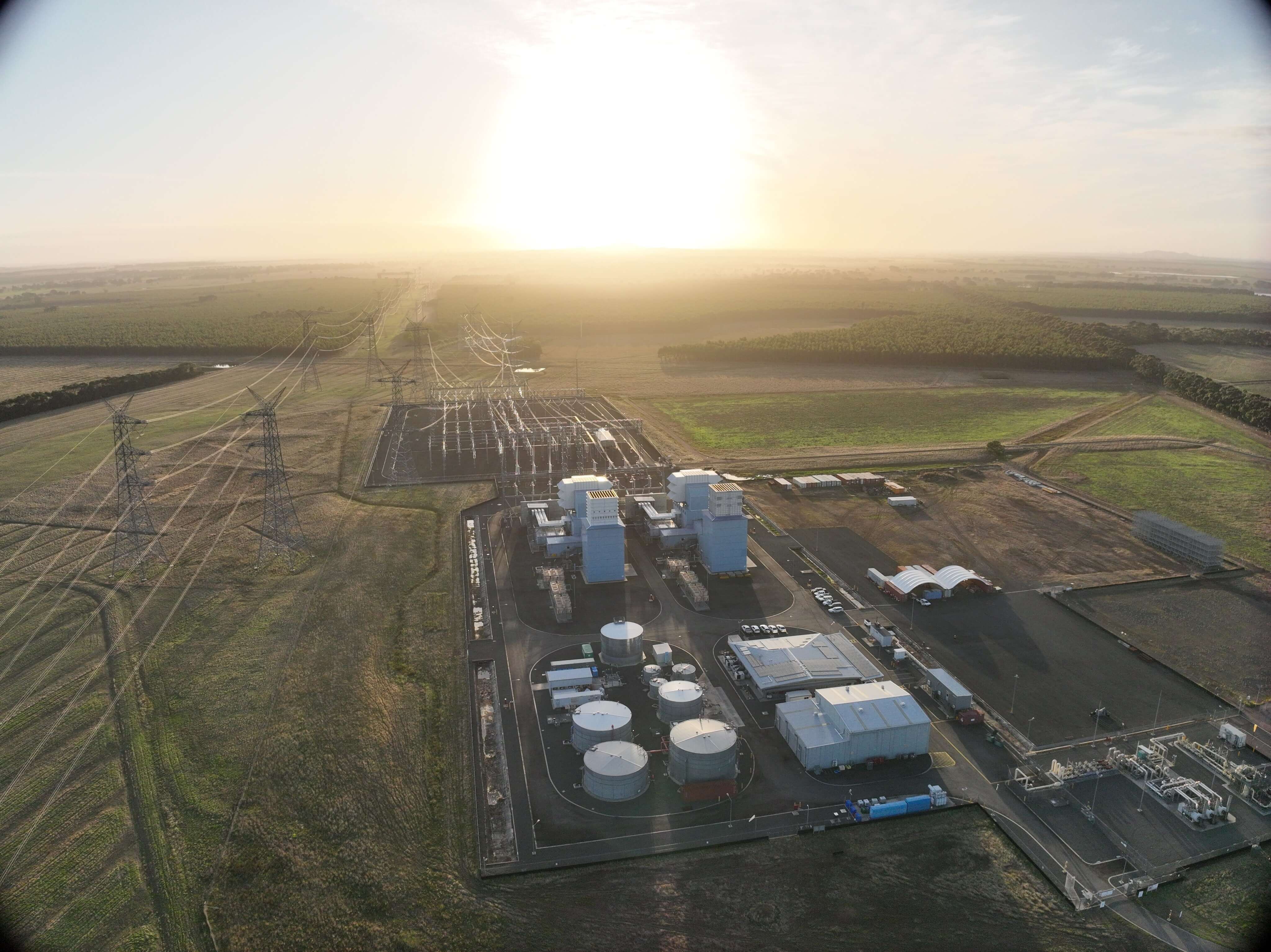
Origin has approved construction of a large-scale battery next to the Mortlake Power Station, with a capacity of 300MW, that is expected to deliver output of up to 650MWh.
Mortlake is Victoria’s largest gas-fired generator, with a generation capacity of 566MW.
Located adjacent to the Moorabool to Heywood 500kv transmission line, the power station also sits within Victoria’s South-West Renewable Energy Zone (REZ). Western Victoria is already home to several operating renewable energy generators, and further new renewable energy developments are expected within the South-West REZ.
Increasingly, large-scale battery energy storage systems are playing an important role in Australia’s energy transition, by supporting renewable energy sources and providing firming capacity and stability to the National Electricity Market.
The Mortlake BESS is expected to be commissioned late in 2026 and will support further renewable project development by charging during the day when renewable energy sources like wind and solar generation are plentiful and discharging into the grid during peak periods.
This Project received funding from the Australian Renewable Energy Agency (ARENA) as part of ARENA’s Advancing Renewables Program.
The views expressed herein are not necessarily the views of the Australian Government, and the Australian Government does not accept responsibility for any information or advice contained herein.
Mortlake Battery Energy Storage System Community Investment Program
Origin has proudly supported communities across western Victoria through community investment programs for more than a decade.
Origin’s community investment targets four focus areas – community wellbeing, community resilience, economic development and the environment.
Origin would like to support local communities in the Moyne Shire area during the construction of the Mortlake Battery Energy Storage System (BESS), located near the Mortlake Power Station.
Applications will be invited for up to $10,000 to support events or activities that align to one or more of the community investment priorities. Events or activities that lead to measurable community outcomes within the Moyne and Warrnambool Local Government area are encouraged to apply.
Priority will be given to projects that are sustainable over the long term and that deliver an enduring community benefit beyond the funding period.
Please read the Mortlake Battery Community Investment Program Guidelines carefully before making an application. The guidelines cover Origin’s investment focus areas in more detail, eligibility (including activities we won’t support) and how applications will be assessed.
If you have any questions or need assistance to apply, please contact powerdevelopmentprojects@originenergy.com.au or call 1800 677 315.
Find out more
Learn more about how large-scale batteries operate and support renewable energy sources
Current status
On 29 January 2024, contracts for the construction of the Mortlake BESS were signed with global energy storage systems supplier Fluence.
Following a period of detailed design activity, the first phase of construction focused on site preparation and civil works, commenced in July 2024 and includes:
- installation and maintenance of environmental controls including drainage and sediment controls
- upgrade of the construction access track from existing internal access road to battery location
- existing easement crossings to access battery area
- cut and fill to level areas and establish a hardstand pad
- structural works slabs to support battery modules, power conversion systems and transformer structures
- continued delivery, installation and electrical fit-out of battery modules, power conversion systems and transformers
- switch room & control room energized
- energisation of AusNet substation
- hot and cold commissioning of the first battery zone
The project is now in commissioning phase and on track to be commissioned in late 2026.
Get the latest information about Mortlake Battery Project here.
Project approvals
On 13 November 2023 the Victorian Department of Transport and Planning endorsed the amended Mortlake Power Station Development Plan and Mortlake Power Station Construction Environmental Management Plan to facilitate the development of the Mortlake Power Station Battery Energy Storage System (BESS).
Keeping you informed

Origin is committed to keeping the local community informed as this project progresses. We will regularly update this site and share news directly with neighbours and local stakeholders as key milestones are met.
Call 1800 677 315 or email powerdevelopmentprojects@originenergy.com.au for further information and to lodge any feedback or concerns.
Frequently asked questions
Why is Origin planning to build a battery at Mortlake Power Station?
Origin’s strategy is to accelerate renewable energy and storage in our portfolio and we expect large scale batteries and other storage technologies to play a vital role in Australia’s energy transition. A large-scale battery at Mortlake will help keep the grid stable and support more renewable energy coming into the system as the market continues to decarbonise. Mortlake’s existing links to transmission infrastructure and availability of suitably zoned land owned by Origin also make it an ideal location for a large-scale battery. A large-scale battery at Mortlake will also play a role in supporting new renewable developments within Victoria’s Renewable Energy Zones.
How do batteries support the transition to renewable energy and decarbonisation?
Renewable energy, such as from solar and wind, needs ‘firming’ capacity that can provide additional electricity to the grid during times of higher demand, or when supply from renewables is lower. Batteries are an example of ‘firming’ capacity that can shift energy from periods of abundant renewable supply into periods of lower renewable supply. The project will also be capable of providing Frequency Control Ancillary Services (FCAS), as well as fast frequency response and synthetic inertia – security services currently under consideration in the National Electricity Market (NEM). Such services help stabilise the electricity system as large generators are being retired from the system.
How will the battery be charged?
The Mortlake BESS will be connected to the grid via an existing switch yard and will be charged by all forms of generation in the market including renewables. It is intended that the battery will be charged from the grid when renewable sources, particularly solar, are plentiful (typically during the middle of the day). After storing for a period, the battery will release that energy back into the system at peak times, including morning and early evening.
Where is the battery located?
The battery will be located at Mortlake Power Station which is approximately 250km west of Melbourne and 50km north of Warrnambool, Victoria. The Mortlake BESS project area is about 8 ha, located on Origin-owned land within the southern portion of the Mortlake Power Station site. The battery will connect directly from a dedicated substation to the adjacent existing 500kV AusNet switchyard.
When are works expected to be completed and the battery fully commissioned?
Origin anticipates that the Mortlake BESS will be commissioned late in 2026.
What are the component parts that make up this project?
The Mortlake Battery Energy Storage System (BESS) project area is about 8 ha, which is located within the southern portion of the Mortlake Power Station site. The Mortlake BESS will include:
- rows of enclosures housing lithium-ion type batteries connected to associated power conversion systems (PCS) and high voltage (HV) electrical reticulation equipment
- a substation housing high voltage transformers and associated infrastructure
- the battery will connect directly from a dedicated substation to the direct adjacent existing 500kV AusNet switchyard, and
- ancillary infrastructure and facilities including safety protection systems and site ancillary facilities such as laydown areas and site offices.
What are the key stages involved in constructing the Mortlake battery?
Construction works will include three main stages:
Site preparation and civil works
- Installation and maintenance of environmental controls including drainage and sediment controls.
- Upgrade of the construction access track from existing internal access road to battery location.
- Existing easement crossings to access battery area.
- Cut and fill to level areas and establish a hardstand pad.
- Structural works slabs to support battery modules, power conversion systems and transformer structures.
Component delivery and installation
- Delivery, installation and electrical interconnection of battery modules, power conversion systems and transformers.
- Installation of 500 kV gantry cabling from the substation transformers to the AusNet switchyard.
- Works to connect the battery to the existing switchyard.
Commissioning and demobilisation
- Testing and commissioning activities.
- Removal of construction equipment and rehabilitation of construction areas.
Will there be more traffic movement during construction?
A detailed Traffic Management Plan has been developed to manage vehicle movements during the construction period to ensure they remain within the local road network capacity limits.
Will there be more noise during construction?
The cut, fill and compaction activities and establishment of structure footings have the potential to generate noise and vibration. Mitigation measures will be implemented during construction activities to minimise impacts to neighbouring properties.
How do you plan to minimise the impact the construction and operation of the facility may have on the local environment and community?
The Environmental Management Plan (EMP) describes how the Project will comply with all relevant statutory requirements, manage potential environmental impacts and ensure appropriate controls are in place to minimise and prevent risks to the environment. A range of separate plans have been developed including a biodiversity management plan, a construction environment management plan, construction traffic management plan, construction surface water management plan and separate sets of plans to manage chance finds (cultural heritage and contamination). There will be high onsite focus throughout construction to ensure compliance with development consent conditions, construction safety and environmental plans and procedures.
How do I provide feedback or raise any concerns during the construction period?
Enquiries and complaints can be lodged to 1800 677 315 or email powerdevelopmentprojects@originenergy.com.au.
How many local jobs will be created for the project?
During the earthworks phase, there will be approximately 40 direct jobs and then approximately 90 additional direct jobs during the main construction and installation phase. There are expected to be indirect employment and business opportunities for local businesses to support construction activities, including workforce accommodation, meal supply, lifestyle activities, local transport, equipment hire and materials supply.
How much will the project cost?
The total project investment for the Mortlake BESS is approximately $400 million.
How many hours of output will the battery have?
The Mortlake battery will have a capacity of 300MW that is expected to deliver output of up to 650MWh. If the battery operates at 300 MW it will be able to provide continuous power output at this level for a little over two (2) hours. The amount of energy that can be stored in the battery is 650 MWh (beginning of life). If the battery operates at a lower power output, it will be able to provide the lower power output over a longer duration. For example, if we operate at a power output level of 150 MW, the battery would be able to provide continuous power output at this level this for over 4 hours.
How long does it take to charge the battery?
At the maximum designed charge rate (300 MW), the battery will take just over 2 hours to charge to energy capacity (650 MWh).
Once operational, will the battery have any environmental impacts e.g. noise from cooling fans?
The battery will create some noise from fans which are used to keep the batteries cool. However, this is expected to be within the permitted levels of the existing power station.
Are there any hazards associated with the battery?
Some early-stage technology Lithium-Ion batteries experienced fires when subjected to impacts or high internal temperatures beyond their design parameters. Design of battery cells, charging management, fire suppression systems and temperature monitoring have progressed over recent years, helping to significantly improve safety and reduce risk. Additionally, the layout of the plant and maintaining spacing between components manages the risk of the spread of a potential fire.
Consideration of fire risk is a key design component for Origin in ensuring the safety of surrounding communities and our employees. We work with key stakeholders, including local emergency services, to ensure response plans are updated and accessible.
What will you do with the batteries at the end of their life?
After 20 years the battery capacity is expected to be 60%. Origin is currently working with suppliers to understand and maximise end-of-life options for the batteries after this time, including re-purposing or recycling of battery components and recovery of rare earth metals within each battery cell.