Your solar questions answered
Want solar for your home but not sure where to begin? Find out the basics about solar panels, inverters and more.

Quick summary
- Solar systems include solar panels plus an inverter
- Inverters convert the energy generated by your solar panels (direct current, or DC) into electricity that your property can use (alternating current, or AC)
- Getting a solar system is the first step in electrifying your home because you’re generating your own electricity from the sun
What are the benefits of solar?
If you’re looking to install a solar system at your property, getting solar panels from a trusted solar provider might be one of the wisest decisions you could make.
Besides collecting renewable energy from the sun, switching to solar can also lower your energy bills, may add value to your home, and is more environmentally-friendly than using non-renewable energy from the electricity grid.

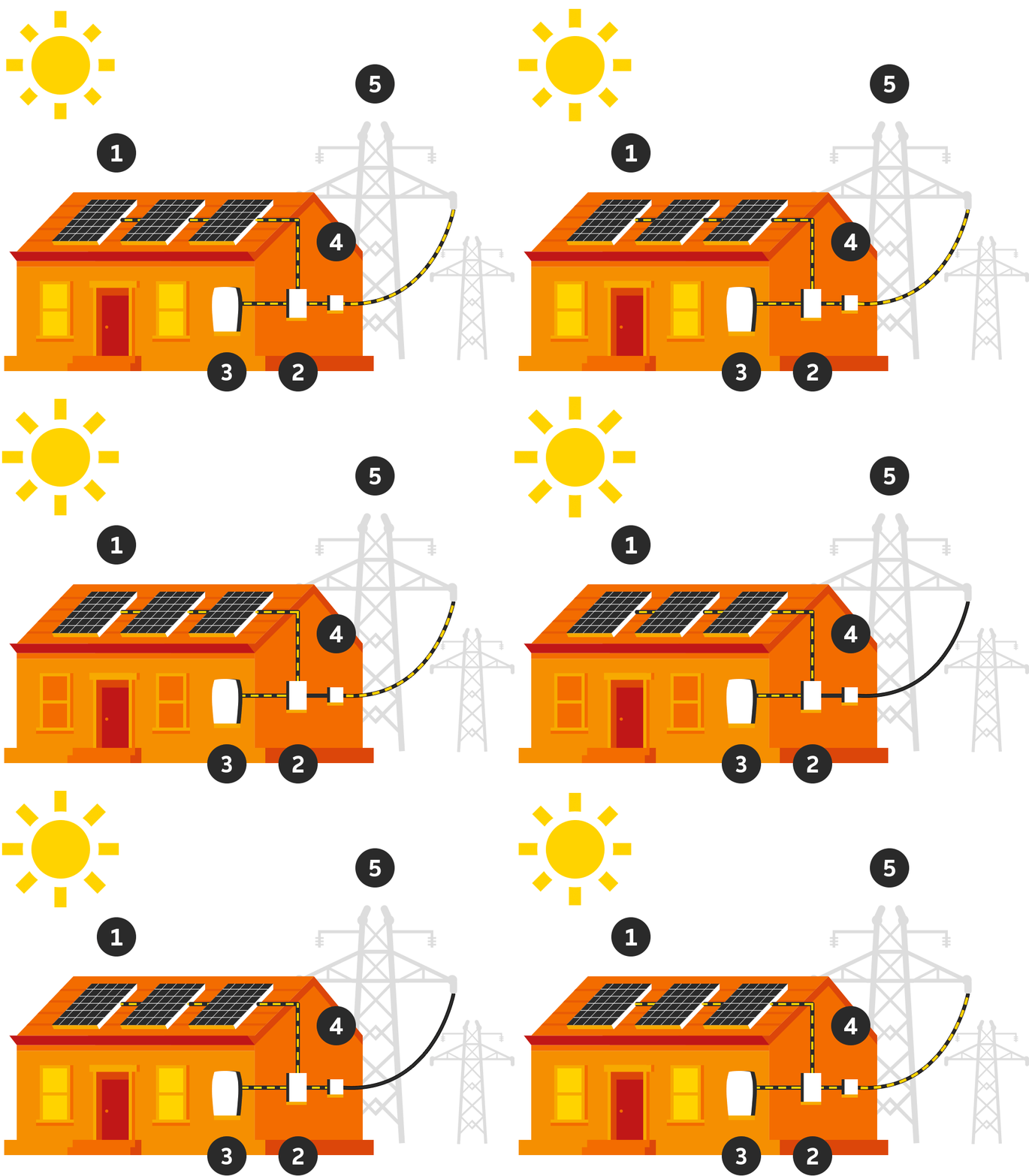
How solar works
1. Solar panels
Solar panels capture clean, renewable energy from the sun and convert it into direct current (DC).
2. Solar inverter
An inverter box does the hard yards. It converts direct current (DC) output from your solar panels into alternating current (AC) to power your appliances.
3. Solar battery
If you install a solar battery, excess energy is stored here instead of being pushed out to the grid. Here’s what to look for when buying a solar battery.
4. Digital meter
Your energy use and habits are easily tracked with a digital meter or smart meter. If you’re an Origin electricity customer, you can monitor your solar self-sufficiency and savings through the Origin app.
5. Power grid
Any excess energy is pushed out to the grid. It’s measured and your feed-in tariff (FIT) is calculated and credited to your account.
What size solar system do I need?
The number of solar panels you need depends your property, location and your energy needs. We can help you get quotes to install solar at your property through our partner, SolarQuotes.
In 5 to 10 minutes, you can be on your way to getting up to 3 free solar or battery quotes for your property through our partner, SolarQuotes. With more than 10,000 five-star reviews and a network of over 550 qualified, trusted installers, you can join 800,000+ Aussies who have requested quotes from SolarQuotes.
It’s free and without obligation+
How much will solar cost?
The price of your solar system depends a few things including the size of your property, the type of roof material you have, the amount of energy you want to generate, and the number of solar panels you need. It’s also important to consider the type of metering you have at your property (single phase or three-phase), any new metering requirements you may need to support the solar system you’d like, if you’re interested in adding battery storage to your solar system, plus more.
It may seem like a lot, but we’re here to help every step of the way. Simply arrange up to 3 free quotes from our partner, SolarQuotes – it’s free and without obligation+
Get the most out of your solar system
You may want to consider:
- using appliances like your dishwasher or washing machine during the day when your solar panels are generating electricity.
- scheduling appliances with timers so that multiple appliances aren’t on at once which can use all your generated power resulting in the need to draw extra energy from the electricity grid.
- keeping up with cleaning and maintenance requirements so that your solar panels are performing at their best.
Did you know that dirty solar panels can significantly reduce their ability to generate solar? It’s generally recommended you get your solar panels cleaned professionally every 6-12 months to remove dust, bugs and dirt, and well as trim any nearby tree branches that may be casting shade over your panels.

Not sure where to start?
Take your first step with our Home Assessment Tool, where you’ll get a personalised plan so you can move at your own pace.
Find an estimate of your future costs and potential savings – plus a checklist to help you with every step – in under 10 minutes.
How can I get solar?
In under 10 minutes, you can be on your way to getting up to 3 free solar, battery, heat pump or EV charging quotes for your property through our partner, SolarQuotes. With more than 10,000 five-star reviews and a network of over 550 qualified, trusted installers, you can join 800,000+ Aussies who have requested quotes from SolarQuotes.
It’s free and without obligation+

Your questions, answered
Keen to take the next step in your solar journey? Here’s a little more information to help you make the most of your solar system and boost your potential solar savings.
Do I have to pay for my solar system upfront?
Getting solar energy for your home is a long-term investment, but that doesn’t mean you have to empty your wallet.
While you can pay for your solar system upfront, you can also chat to your chosen installer via our partner, SolarQuotes, to learn about their finance terms and plans they have available.
Will Origin pay me for my excess solar energy?
A solar feed-in tariff (FIT) is a credit that goes towards your electricity bill when you “sell” or “feed in” your unused solar energy back to the grid.
There are different feed-in tariff rates for each state. Browse Origin’s solar energy plans with great feed-in tariff rates now.
What if the sun isn’t shining?
When the sun isn’t shining, your solar panels won’t be generating electricity – but there is a solution to hand. With solar batteries, you can effectively store excess energy generated from your solar panels during the day and use it at night. Learn more about solar batteries.
Are there any solar offers or rebates available?
Yes – Federal and state governments offer rebates and discounts on solar packages from time to time. You can use the energy.gov.au rebates and assistance tool to help you find what’s available depending on where you are in Australia.
Can I track the solar savings I’m making?
For Origin electricity customers, the Origin app makes it easy to check how much energy you’re using and the amount of solar you’ve fed back to the grid. You’ll also be able to see the credits you’ve earned in the process.
What if I already have solar panels?
Moved into a house with an existing solar system or just installed a new one? Get great value from your solar system with an Origin electricity plan that suits your needs and rewards you for supporting the grid.
How do solar panels work?
Solar panels, or solar PVs, are made up of units called solar cells also called ‘photovoltaic cells’. High-purity silicon is used to make most solar cells, which acts as a semiconductor.
When sunlight passes through a few layers of silicon, the photons from sunlight knock electrons free from atoms, which generates an electrical charge. Just think of solar panels like a sandwich.
- The top layer of silicon will have phosphorus mixed into it to give it more electrons, which gives it a negative charge.
- The bottom layer of silicon will contain boron to produces fewer electrons, which gives it a positive charge.
- The positive and negative charges create an electric field in the middle layer.
When sunlight hits this electric field, photons knock the electrons from the field and send them to wires on the edge of panels. The wires feed to an inverter that then turns these electrons into a form of electricity, which powers your home.
What’s the best placement for solar panels?
Making sure your solar panels operate as efficiently as possible helps you get the best out of your solar system. Besides the number of solar panels, its location and roof direction, you’ll also need to consider the tilt of the panel and its horizontal angle relative to north (the azimuth).
When you arrange your solar installation through our partner, SolarQuotes, your chosen installer will design a system and arrangement of panels on your roof to optimise your energy outputs.
What is a solar inverter?
An inverter is basically a box which takes the energy from your solar panels and turns it into energy your house can actually use. Without a solar inverter, you wouldn’t be able to use the energy from the sun to power your fridge, television or air conditioning.
It’s one of the most sophisticated and important parts of your home solar system – and a nifty little piece of tech.
How does an inverter work?
While solar panels will produce direct current (DC), your home and all the appliances within it uses alternating current (AC).
The solar inverter takes the direct current from your solar panels and turns it into an alternating current that your home can use as power.
So what’s the difference between the two energy types? A direct current basically runs in a straight line, whereas an alternating current looks more like a wave.
The solar inverter contains within it something called a “transformer” – which as its name suggests, transforms one thing into another.
Do I need an inverter?
Yes – the solar inverter is crucial to the process of feeding energy back to the grid, because it produces the same kind of alternate current the grid uses.
Solar panels produce direct current and in its pure form isn’t suitable for the grid. So, without the inverter you couldn’t feed energy back to the grid and earn feed-in tariff credit on your power bill.
Looking for more about solar panels?
Check out the Solar 101 guide according to SolarQuotes to help you on your solar journey.
SolarQuotes is Australia’s top solar website with over 15 years’ experience providing transparent, honest and independent advice on all things solar.
Important information
+ SolarQuotes is an Origin Group company, and Origin receives a commission from them for each referral