Seymour Whyte and Origin EV: a data-led partnership powering fleet electrification
September 2026
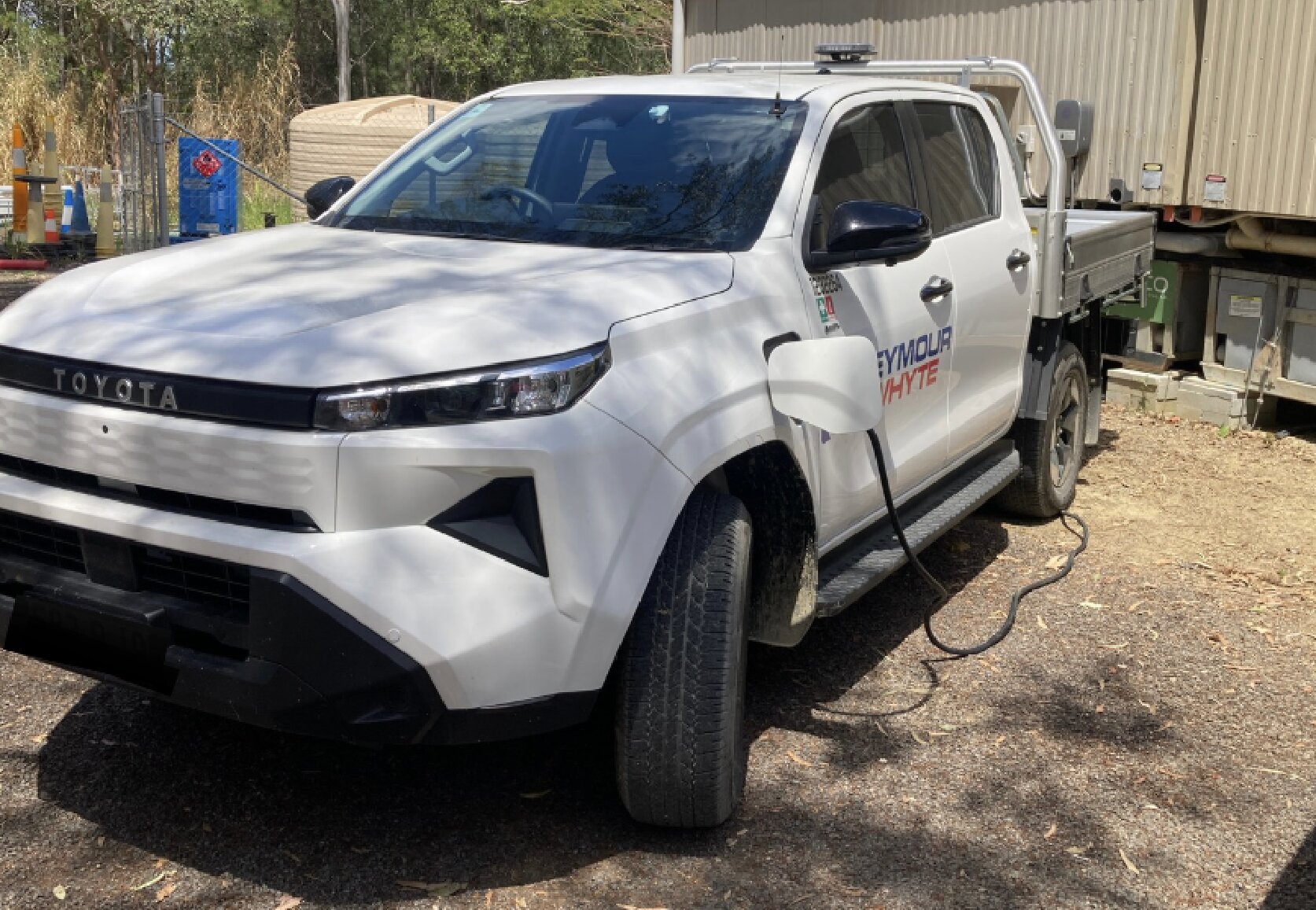
Seymour Whyte has built its reputation as a multi-award-winning civil contractor delivering major essential infrastructure across Australia.
Lately it has been quietly building something else, one of the larger electric vehicle fleets in the civil construction industry.
With 33 EVs already in Seymour Whyte’s fleet, Plant Manager Luke Besant expects the number to exceed 40 by the end of 2026. “The whole approach has been very strategic” says Besant.
The team has prioritised practical outcomes over visibility, carefully matching vehicles to drivers and building trust through each successful experience.
“The feedback on our EVs has been incredibly positive. The more we introduce into the fleet, the more interest and demand we see from our people.”
Luke Besant – Plant Manager, Seymour Whyte
Starting with charging
Seymour Whyte started with three electric LDV utes, using the rollout to gather practical insights into vehicle performance, charging requirements and day-to-day operations. Installing chargers alongside the vehicles was a deliberate decision designed to make charging convenient and support their successful adoption.
“For EVs to be practical in our business, charging needs to be available at our project offices,” Besant says. “Site utes are a strong use case because they return to base regularly and can charge during the working day.”
While EVs are well suited to some project environments, access to reliable power remains a significant consideration. Sustainability Lead Stephen Mount says several Seymour Whyte projects are operating at, or close to, the limits of their available grid capacity.
At one project, EV chargers could only operate overnight to avoid overloading the site’s electrical connection.
“Our approach isn’t about replacing everything with EVs,” Mount says. “It’s about using them where they make practical and commercial sense, while delivering a genuine environmental benefit. The conditions are different on every project, so there is no single solution.”
To navigate these constraints, Seymour Whyte engaged Origin’s electrical engineering expertise to assess each project’s power availability and develop charging solutions tailored to its operational needs.
Seymour Whyte has adopted a flexible approach to charging infrastructure, purchasing chargers as company assets that can move with the business.
As each project is completed, its chargers can be relocated to another site, extending their working life and avoiding the need for every project to purchase new equipment. At the Palm Beach to Tugun project, chargers supported operations for almost three years before being moved to a nearby project at Coomera, where they are expected to operate for a further two and a half years.
With project lifecycles ranging from 18 months to four years, redeploying chargers across consecutive projects reduces the cost of electrification, maximises the value of the infrastructure and helps new project offices become EV-ready sooner.
Data: the missing link
For Michelle Nation, who leads Safety, Environment and Quality at Seymour Whyte and supports the program, the real prize is evidence.
“Facts and data are what we need. Having visibility over our electricity use influences the next steps we take in reducing our carbon footprint,” Nation says.
That gap is exactly what the team is now closing with Origin.
Vehicles had been charging “here, there and everywhere” from home power points, public chargers, on-site units, with little visibility on cost, charge duration or consumption.
By consolidating onto Origin’s OneCharge EV fleet charging service, Seymour Whyte can now track, analyse and manage charging kilowatt-hours and cost per vehicle across both its own chargers and the public charging network through an aggregated view of the data.
The OneCharge service also simplifies EV charging for fleets because, as of August 2026, it brings together 65% of Australia’s public charging network, on-site chargers plus the charging at drivers’ homes.
With a single app and RFID card there are no accounts to create, no payments to make by drivers, no expense claims to process. Sessions can activate automatically, and all costs are consolidated directly onto a single fleet invoice replacing fuel cards.
“Once we have the charging information over time, we can confidently say what the benefit is. Then either narrow the use case to something specific or expand the program.”
Stephen Mount – Sustainability Lead, Seymour Whyte
With the FBT exemption for EVs set to taper from around 2029, that cost data will be decisive.
“Data, cost information and facts are really important. This transition is more complex than I anticipated, you’re trying to move a large organisation of 800-plus people. You can only advocate for these things with facts,” Mount says.
The payoff is bigger than any single decision. Reliable data lets the team match vehicle types to genuine need, shift charging to cheaper off-peak power, and make the case for EV adoption to leadership with confidence rather than optimism.
Interested in testing EVs for your fleet?
Discover how Origin EV for Fleet can help your business save on fleet operation costs and contribute to your organisation’s carbon reduction strategy.